
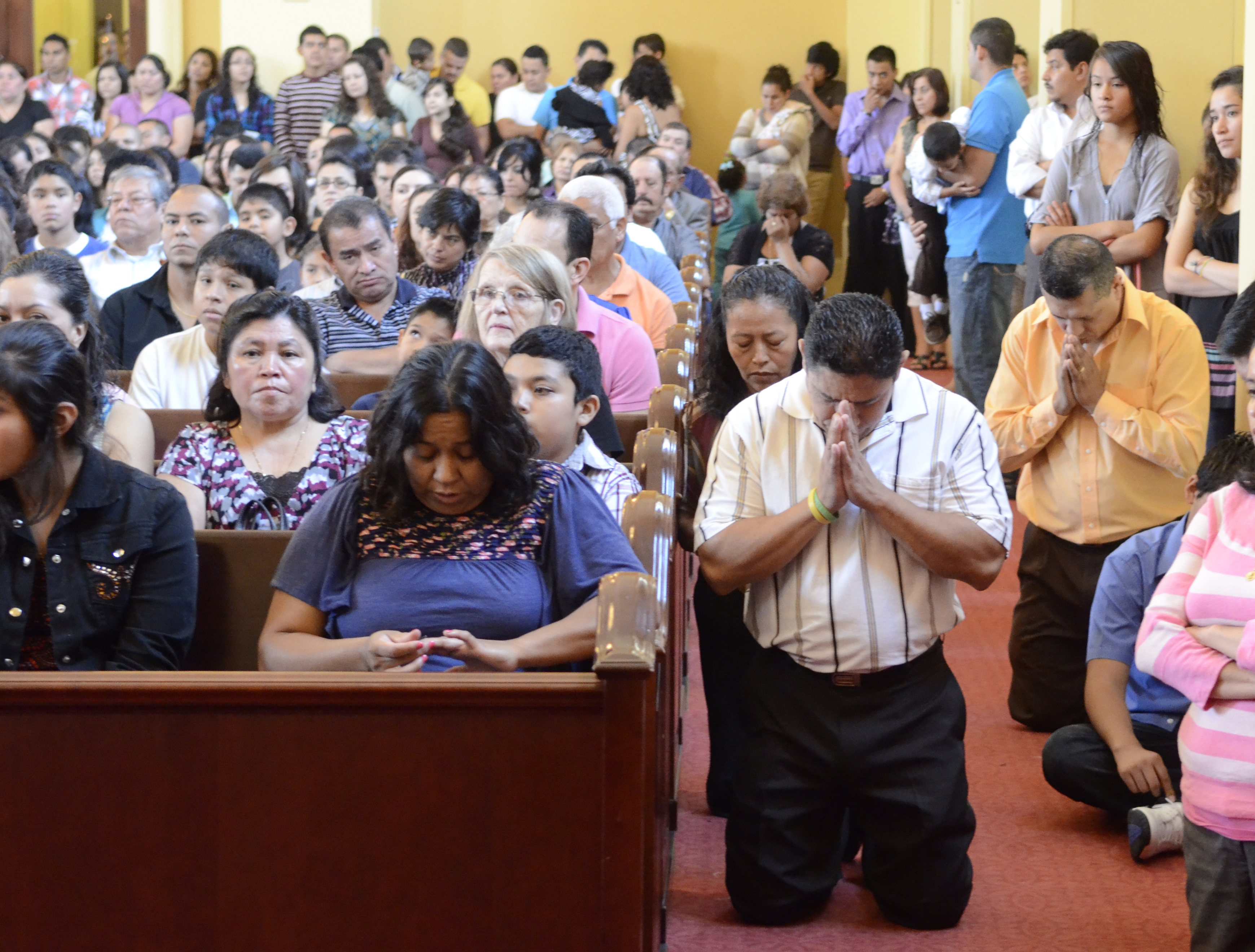
 Spanish language Mass at the St. Joseph Catholic Church in Dalton, Ga., is attended by an overflow crowd.
RELATED STORY
Hispanics still are showing up for school in Georgia after immigration law
IMMIGRATION FAST FACTS
In the United States, 40 million people are foreign born. Out of those, 72 percent are legal immigrants and 28 percent unauthorized.About 4.5 million U.S.-born children were born to at least one unauthorized parent.Inflows from unauthorized immigrants from Mexico have decreased from 500,000 a year during the first half of the decade to 150,000 per year from 2007 through 2009.In Georgia, about 325,000 unauthorized immigrants are in the labor force, 7 percent of the total share – making it one of the states with the largest number and share of unauthorized immigrants in the labor force.In Whitfield County, the Hispanic population increased from 18,419 in 2000 to 32,471 in 2010, a 76.29 percent change.Source: Pew Hispanic Center
Moving Out
The number of illegal immigrants in Georgia declined from 475,000 in 2007 to 425,000 in 2010, according to the Pew Hispanic Center. Unauthorized residents only represent 4.4 percent of the total population in Georgia, but the increase from 1990 to 2010 was twelvefold. Twenty years ago, there were only 35,000 illegal immigrants in the Peach State.
ALABAMA LAW
A federal judge allowed most of Alabama’s immigration law to go into effect, now considered the strictest in the country.Among other things, school officials are required to check the immigration status of students. The law now allows police officers to check the legal status of those detained for other reasons and to hold suspected illegal immigrants without bond.Parts of the law still blocked include making it a crime for an illegal immigrant to solicit work, to transport or harbor an illegal immigrant, and barring drivers from stopping along a road to hire temporary workers.Similar laws have been passed in Arizona, Utah, Indiana and Georgia, but parts of those laws have been blocked by other federal judges.Source: The Associated Press
ABOUT THE GEORGIA LAW
Jan. 1, 2012: People who apply for public benefits, such as housing assistance, food stamps and business licenses, must provide a “secure and verifiable” document to show proof of legal residence.Private employers with 500 or more employees must register with and use the federal work authorization program known as E-verify.July 1, 2012: Private employers with 100 or more employees but fewer than 500 employees also must use E-Verify.July 1, 2013: Private employers with more than 10 employees but fewer than 100 employees also must use E-verify.Under the law, a seven-member Immigration Enforcement Review Board was created to investigate complaints from registered voters that city, county and state officials are not enforcing immigration-related laws in Georgia.Public employers and local governments must submit a compliance report every year to the state auditor. Subject to available funding, the state auditor is required to do a number of audits.Source: Georgia General Assembly