
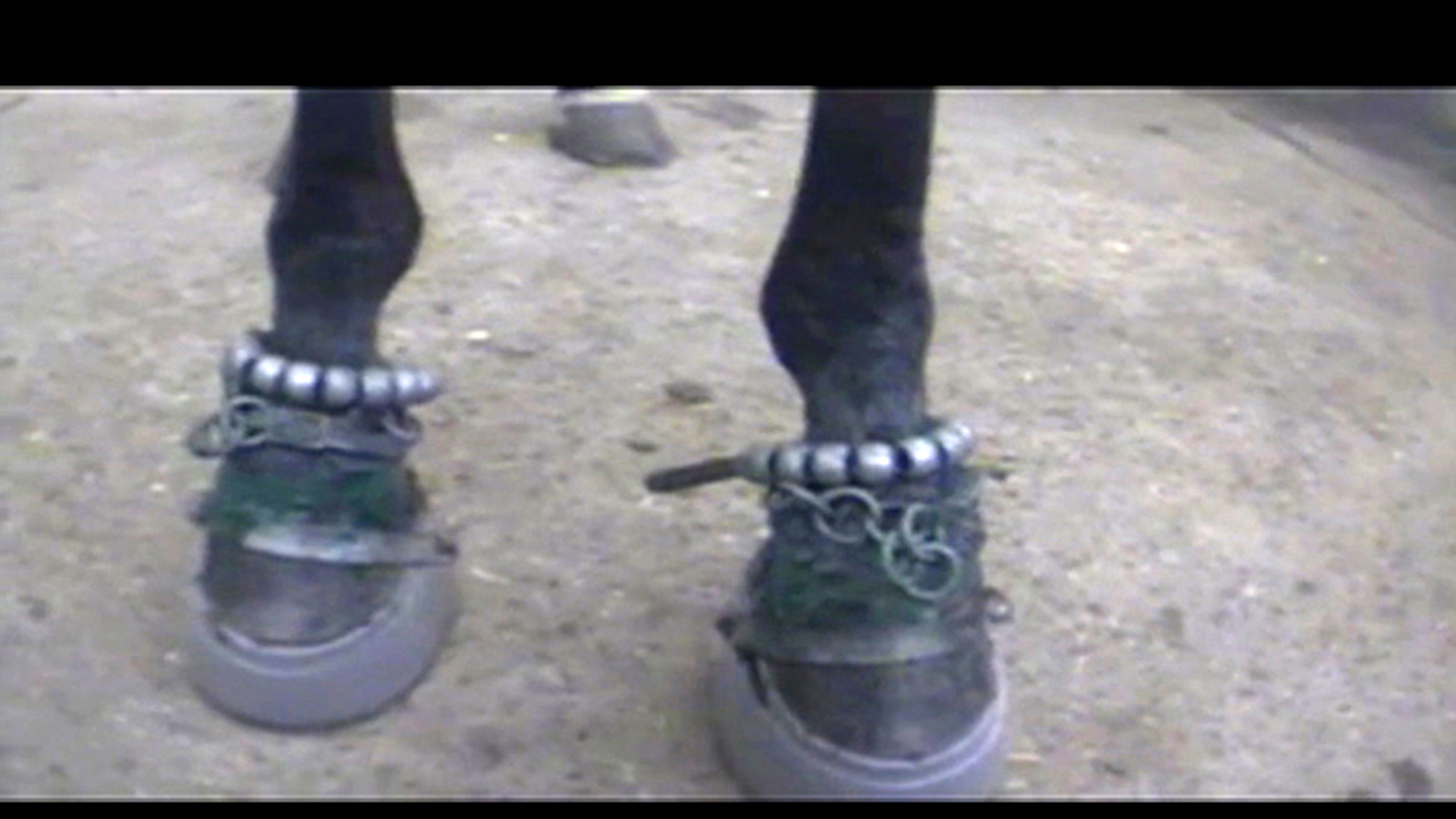
 A frame captured from video of a Humane Society of the United States investigation show the measures taken to produce the exaggerated stride of Tennessee Walking Horses. In the video, horses are struck with clubs, shocked and have their hooves treated with chemicals and mechanical devices.
SORING BY STATESince 1986, USDA has tallied 9,777 Horse Protection Act suspensions against Tennessee walking horse owners, trainers and handlers. More than one-third went to Tennessee competitors, though the USDA records include handlers from 38 states. The top 10 states are:Tennessee: 3,319Kentucky: 1,292Alabama: 681Mississippi: 490North Carolina: 444Georgia: 365South Carolina: 281Virginia: 231Texas: 215Missouri: 176Source: USDA, Friends of Sound Horses
When federal horse welfare inspectors proposed mandatory minimum penalties for Tennessee walking horse abuse, they based their decision on some startling numbers.
In recent years, federal inspectors have attended only about 7 percent of all horse shows, but the shows that U.S. Department of Agriculture inspectors oversaw accounted for more than half — and sometimes up to 80 percent — of violation tickets written by the horse-industry helpers who do the lion’s share of monitoring for horse abuse.
The most active set of industry inspectors, a group that has overseen the Tennessee Walking Horse National Celebration event, wrote 477 violations at 252 shows in 2008. But 280 soring violations, or 59 percent, were written at the 16 shows USDA inspectors also attended.
Soring uses chemicals and devices to make the legs of Tennessee walking horses tender and painful, causing them to reach their high-stepping, contest-winning gait step within less training time.