
“What if salvation is universal?” The priest held some silence, then repeated his question, this time with even more emphasis on “if.” I leaned back in my chair, arms crossed, and waited for it: God only saves Catholics, everyone else is doomed to hell. (Or maybe purgatory. I don’t know, I’m not Catholic).
But he continued: “If it is, I’d be overjoyed.” I sat up. “Sure, in part of my heart, I’d be making a list,” the priest half-joked. “Okay, maybe everyone… except him, or him.” But I’d be overjoyed.” He made some other points, I’m sure very good, but I was too stunned to take them in.
Here was a Catholic priest — a Jesuit, nonetheless — entertaining the idea that salvation might be universal. And he wrapped up like this: “What if salvation is universal? We don’t know. We can’t know. Maybe it is. Maybe it isn’t.”
Again, I’m not sure now what other points he made. I just couldn’t believe what I was hearing.
I grew up in churches that preached that only Christians go to heaven, and we must do all we can to save everyone from damnation. That’s a lot to put on anyone, especially a kid. For most of my life I thought that was a dogmatic, fundamental, core belief of Christianity. It’s part of the reason I didn’t go to church for five years. I just couldn’t deal with the idea that a loving God would sentence most of the world to death. And I definitely couldn’t deal with my failure to save even one of those souls from hell in all of my years.
Hearing a priest leave that question open healed something deep in me. Maybe, at the end of the day, it just doesn’t matter how I think salvation works. Here was a priest, a person entirely dedicated to God, more well-studied than I’ll ever be, more deeply engaged in God’s work than I can imagine, standing in front of a congregation at Mass saying, “We can’t know.”
I’m sure he has his own stance on the matter. He might believe universal salvation is a heresy. I have my own stance, but I agree that we can’t know, not in this life, and not with our limited, mortal, imperfect intelligence. But here’s my theory on why he said it, regardless of his belief: He didn’t know us.
I heard this homily while my fiance and I were on a silent retreat at a Jesuit center near Atlanta. It was explicitly open to people of any (or no) faith tradition. Some attendees were Catholic, but some, like us, weren’t. One couple shared a very deep hurt inflicted by the Catholic church as they each walked through the annulment process. No doubt we were all in very different seasons of life and faith, both as individuals and as couples.
So the priest chose a message of love. He recognized that it simply doesn’t matter, in that moment, how salvation works. I think he also recognized that this is one of the biggest sticking points among my generation, especially among people who have left the church. Many of us just can’t believe that the same God who is supposed to love us unconditionally actually does have a condition.
I think he left the door open on that question to invite us back into God’s love.
Of course how God works matters, and how His salvation works matters. Just like how my microwave works “matters.” But I don’t have to understand my microwave to use it. All I have to do is use it and let it be what it is. I don’t have to learn about capacitors or radiation or anything.
Maybe that’s all any of us have to do with God. Love Him and let Him be, without demanding explanation. He’ll accomplish His work with or without us, exactly how He wants it to be done. He is, after all, almighty God. And whether or not I understand His work doesn’t make one ounce of difference.
What does make a difference is how I love the people around me, how I love Creation in all its glory and how I use this one precious life. It matters that I make people feel loved and accepted. It matters that I do my best to be a good steward of all the things that are given to me, from my money to my education to my time to my business. It matters that I meet God and contemplate His love and admire the beauty all around me.
What doesn’t matter is arguing about whether salvation is universal. We simply can’t know. And I like to think it wouldn’t change how I live my life, either way.
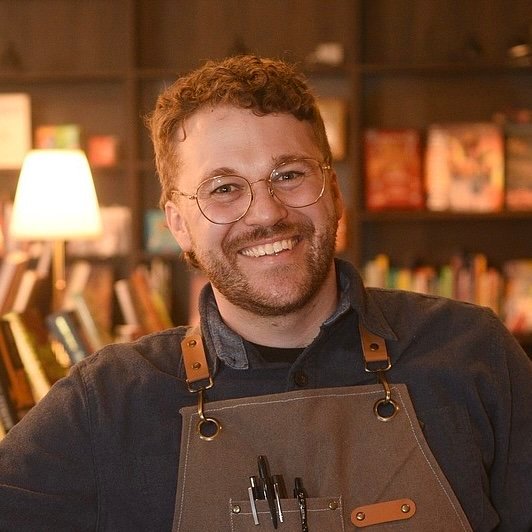
Spencer Pennington runs Pennington’s Books and attends Sunday services at various local churches and on his back porch. Email him at slpennington@proton.me.