
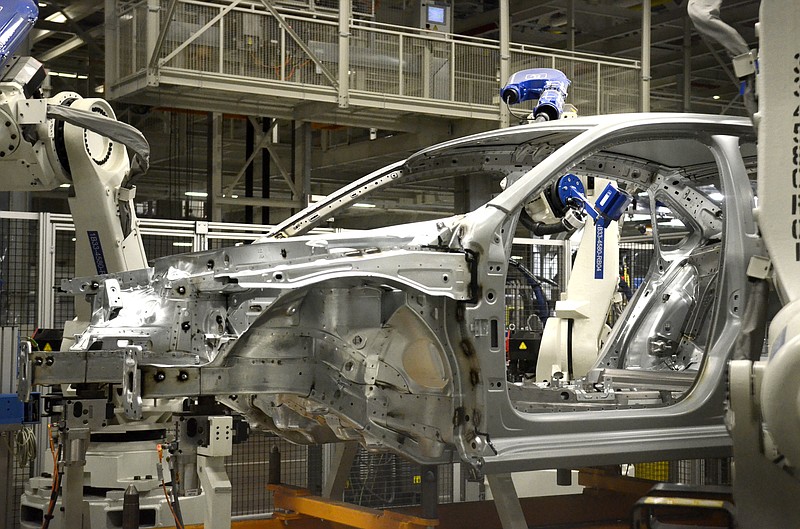
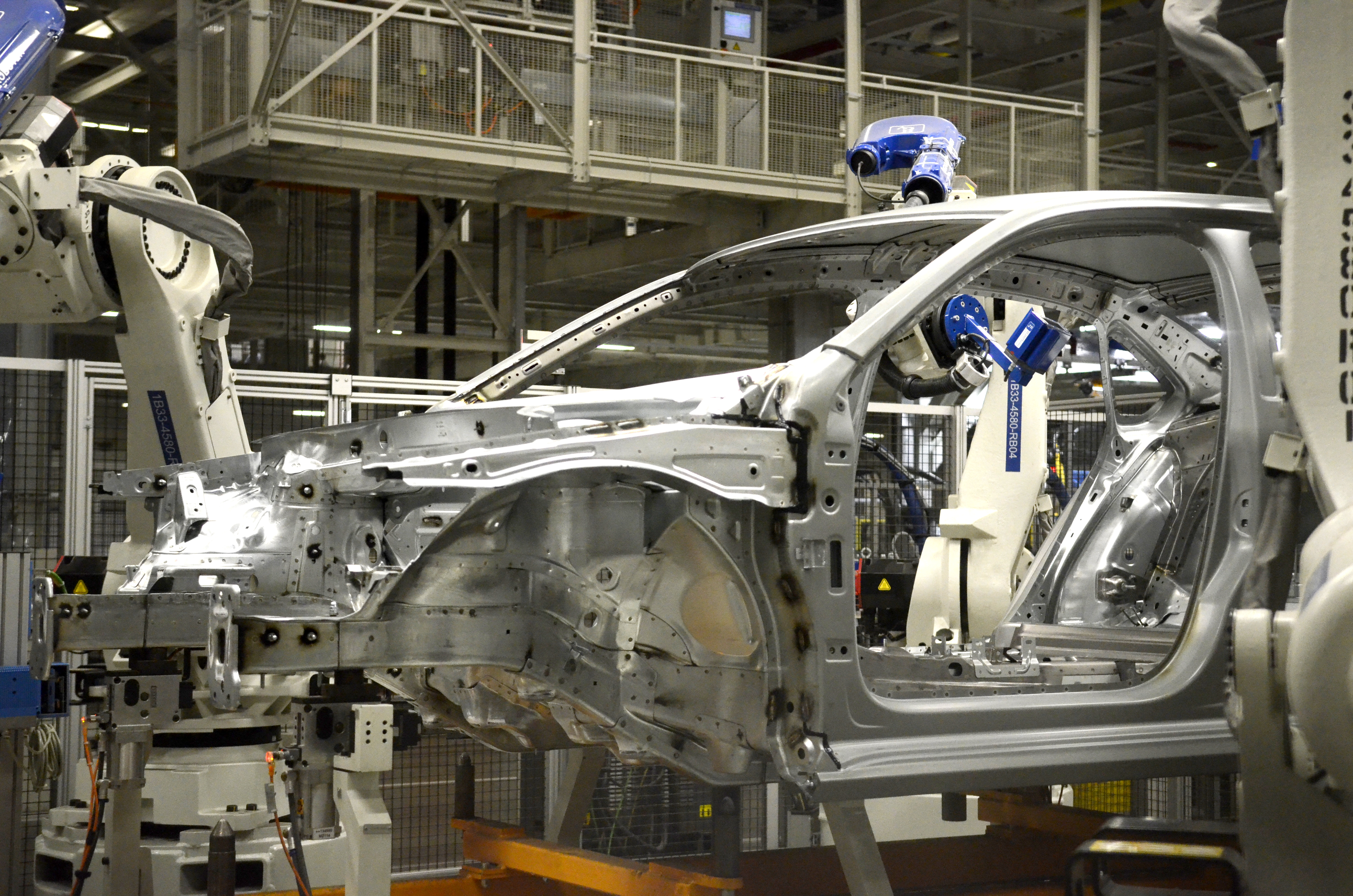
 A Volkswagen Passat chassis gets a robotic inspection at the Chattanooga manufacturing plant Thursday.
GREEN PLANTSix-inch exterior wall insulation cuts energy consumption 35 percentPaint process cuts carbon dioxide emission by 20 percentEfficient paint shop saves 20,000 gallons of water a dayReuse of rainwater for cooling and restrooms saves up to 350,000 gallons of water monthly71 percent of waste produced at plant is recycledPower-efficient light tubes inside save 20 percent in energy usePlant heat exchangers capture and recycle heat for air in buildingsLED street lighting saves 100,000 kilowatt-hours per yearProtected wetlands, habitats for native vegetation defined on siteTwo creeks on site restored during constructionSource: Volkswagen
Three years ago, Chattanooga's Enterprise South industrial park was a 7,000-acre brownfield.
Today, it holds the greenest auto plant in the world and one of the globe's most environmentally friendly factories, officials said Thursday.
Volkswagen's $1 billion auto assembly plant has garnered the highest Leadership in Energy and Environmental Design rating.
The U.S. Green Building Council awarded LEED Platinum status to the factory, and a VW official compared the ranking to the Motor Trend car of the year award the Chattanooga-made Passat won last month.
"What Motor Trend means to the car, LEED means to the plant," said Frank Fischer, chief executive of VW's operations in the city.
Judith Webb, the group's chief marketing officer, said no auto plant has ever secured the top LEED badge. A General Motors plant in Michigan is gold LEED certified.
Webb said there are only four manufacturing plants worldwide - a Coca-Cola factory in China, two lingerie plants in Sri Lanka and an LCD maker in Taiwan - to have achieved the platinum level.
"Doing LEED platinum is hard," she said, adding that only 3 percent of the 11,000 LEED-certified buildings hold the top designation. "The level of achievement is breathtaking."
"a benchmark"
Jan Spies, VW's head of factory planning worldwide, termed the LEED ceremony with about 200 Germans and Americans at the plant "a very special moment."
"This plant is very much the benchmark in Volks-wagen," he said about the local facility that's one of VW's more than 60 factories globally.
Spies wouldn't give a dollar figure of how much it cost to go for the green rating, but put the number as a single-digit percentage of the total plant price.
Dieter Schleifer, manager of plant infrastructure for VW in Chattanooga, said the factory was built to avoid wasting any energy.
He estimated energy savings are about 42 percent better than a standard U.S. building.
Fischer noted how Chattanooga was labeled in a 1969 CBS news report as having the dirtiest air in America. Now, he said, the city has environmentally changed.
"We're glad to add to that legacy of sustainability," he said.
Hubert Waltl, the VW brand's board of management member for production and logistics, said what was learned in Chattanooga will be transferred to other facilities worldwide.
LEED is "very ambitious," the VW official said, but environmental responsibility is key to the automaker.
vw academy
Hans-Herbert Jagla, VW's executive vice president of human resources in Chattanooga, said the adjacent Volkswagen Academy also drew LEED platinum status.
He called that facility VW's most modern training academy globally.
Chattanooga Mayor Ron Littlefield said that three years ago, there were few jobs at the industrial park. Now, with the addition of VW, its supplier park, and Amazon, about 5,000 people are working at the site.
Hamilton County Mayor Jim Coppinger said he was told the VW plant's energy savings would power 750 homes annually.
"That's a remarkable feat in itself," he said.
Tom Edd Wilson, the Chattanooga Area Chamber of Commerce's CEO, said VW's top LEED rating can help its business recruiting efforts.
"Companies today are much more aware and interested in being good stewards of the environment," Wilson said.
Tim Spires, who heads the Chattanooga Regional Manufacturers Association, said he spent about 30 years in the sector and is familier with the difficulty in attaining the green ranking.
"I know the effort it took," he said.
Bob Colby, executive director of the Chattanooga-Hamilton County Air Pollution Control Bureau, said for the city to be home to the world's cleanest auto assembly plant "serves as a beacon to what can be done."
U.S. Sen. Lamar Alexander, R-Tenn., said in a statement that over the past 30 years, Tennessee has become the hub for the American auto industry.
"Now it also is home to the first-ever platinum LEED-certified auto assembly plant, showing that a car company can lead in both making good cars and preserving the environment," he said.