

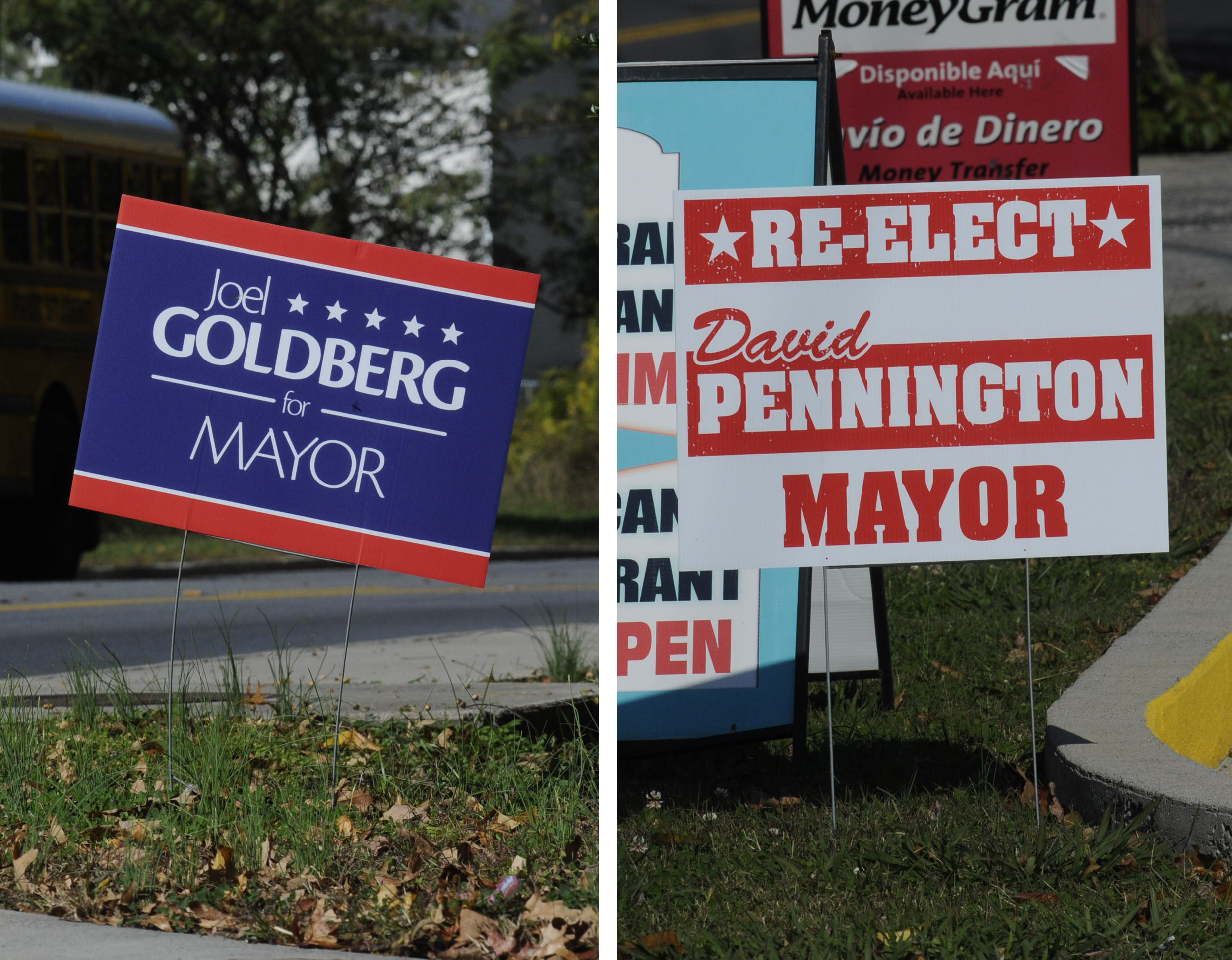
 Election signs for Daltaon mayoral candidate Joel Goldberg and incumbent mayor David Pennington are seen next to city streets in Dalton.
Voters in four Northwest Georgia cities will decide Tuesday who their mayors will be, and it wouldn't be campaign season without promises of spending cuts and growth plans, and a little mudslinging.
In Dalton, a mayor's race that began with little fanfare has heated up in recent weeks. Incumbent David Pennington touts his tax cuts and a reduced city budget, while political newcomer Joel Goldberg argues the tax cuts have hurt city services and Dalton's ability to attract business.
"This is no time to be raising taxes," said Pennington. "We are well-positioned to weather this storm and begin reinvesting in Dalton."
Goldberg, a 41-year-old accountant and consultant with Medical Business Concepts, disagrees.
"Eliminating property taxes sounds really good, but at some point it will start affecting the level of services," he said. "We are not going to attract a diversified industry just because we don't have a property tax."
Since Pennington has taken office, he and the City Council have cut property taxes by about 23 percent and shrunk the city budget 10 percent.
Both men have poured significant resources into the race for a part-time position that pays an annual salary of $7,200.
Pennington raised $20,000 and has spent about $15,000 so far in ads and campaign signs, similar to numbers he spent in his first election in 2007.
Goldberg has raised about $8,000 in donations, with all of that going toward signs, pins and ads.
Initially, Pennington appeared to be the favorite, but now even Pennington supporters say the race is close.
Signs for both candidates dot many yards in the city, and a recent debate at City Hall was standing room only.
Juan Lama, a Pennington supporter, said he no longer attempts to talk local politics with some of his friends, who support Goldberg.
"They want to spend money we don't have," Lama said about Goldberg supporters. "We are all making sacrifices at home right now; governments have to make those sacrifices, too."
George and Mary Lee Farmer are firmly on the other side of the fence, with a large Goldberg sign in their yard. Their grown children also support Goldberg, they said.
Mary Lee Farmer said Goldberg is "young, energetic and looking ahead to the future."
Tax cuts are hurting the city, 76-year-old George Farmer added.
"Someone is going to have to bite the bullet somewhere and pay more taxes," he said. "I don't think you can keep cutting taxes and have the level of services that the citizens of Dalton want."
Goldberg also opposes a potential city and county merger, which is being studied by a charter commission. He accuses Pennington of changing his position on the merger in recent weeks.
Pennington was one of the leaders involved in initial talks about the merger and pushed to pass state legislation to form the charter commission.
He said last week he supports studying the merger but doesn't know whether he will support it until the charter commission provides its report.
While Pennington's tax and spending cuts - supported by the city council - have garnered supporters, others dislike the cuts and his leadership style.
He has been critical of the Dalton city school administration, questioning its use of money and decisions to build new schools. He cut positions in almost every city department, including fire and police.
Goldberg called his opponent "abrasive."
"Our styles couldn't be more different," he said. "I'm a consensus type of guy; I'm going to look for common ground."
Cuts in spending have hurt city services, Goldberg said, citing roads that are no longer adequately paved and a lack of code enforcement.
Pennington disagrees that the cuts have affected residents, but he readily admits he is not politically correct.
"I can be abrasive if people want to waste taxpayers' dollars," he said.
In Dalton, where the unemployment rate hovers well above state and national averages, Pennington opposes incentives to attract businesses. Cutting taxes will support struggling local businesses and attract new development, he said.
Goldberg said economic development is his primary goal, promising to "throw everything including the kitchen sink" at the problem.
"I will travel to Germany; I'll travel to California. I'll go anywhere I need to go," he said.
TRENTON
City finances also are a factor in the Trenton, Ga., election, where three men are competing to be mayor.
The recession, a major plant closure and cleanup costs from April's tornadoes have left the city tight on funding for operating expenses.
Challengers Tommy Lowery and Anthony Emanuel say the city's budget needs to be trimmed so reserves can be rebuilt.
"That might mean some tough decisions have to be made on what we spend on what," Lowery said.
Emanuel said the budget needs to be reduced and departments must find ways to keep expenses down.
"It's one thing to offer a balanced budget, which the state requires, but it's another thing to stay within that budget," he said.
But incumbent Barton Harris said he and other leaders have done well to keep things from getting worse without a major tax increase.
"The city of Trenton is running really lean right now," he said. "The city's doing all we can do keep taxes low and keep everybody under budget."
FORT OGLETHORPE
In other areas, managing and promoting growth have taken center stage.
Fort Oglethorpe Mayor Lynn Long seeks to retain his seat against former Catoosa County Commissioner Ken Marks, and both candidates have made growth a priority.
Long said the city needs to "stay on the path" and leaders specifically need to focus on revitalizing the strip of LaFayette Road from Battlefield Parkway to the Chickamauga Battlefield.
Marks said his main focus as mayor would be growing the city through new development and annexation, particularly in the Dietz Road area and along Cloud Springs Road.
Neither man's campaign finance reports were available on a state website, but signs and banners have blanketed the city for months.
Long, 67, a former Catoosa County Commission chairman, won a special election over a crowded, experienced field last year to replace the late Ronnie Cobb, who died of heart disease.
Marks, 60, a close friend of Cobb, said he considered running in the special election but needed time to be sure he was making the decision "with my head, not my heart."
ROSSVILLE
In Rossville, the government's role in potential growth has become a divisive point between two mayoral candidates.
Former fire Chief Bill Eaves, 69, said he's heard from plenty of voters who are upset with the Rossville Downtown Development Authority and the way it handled the acquisition and resale of Roy's Grill, the iconic restaurant on U.S. Highway 27. Eaves said he had a business that stood on its own for 25 years without government help.
"I don't think the city needs to be in the financing business," Eaves said.
But Councilman Teddy Harris, 48, is one of the RDDA's biggest supporters and said the authority's involvement is crucial to getting downtown moving again.
"If we don't invest in our downtown, it's going to be what it is," Harris said. "If you do nothing, you're going to get nothing."